
Robotic Knee Replacement
A knee replacement designed around your anatomy — not the other way around.
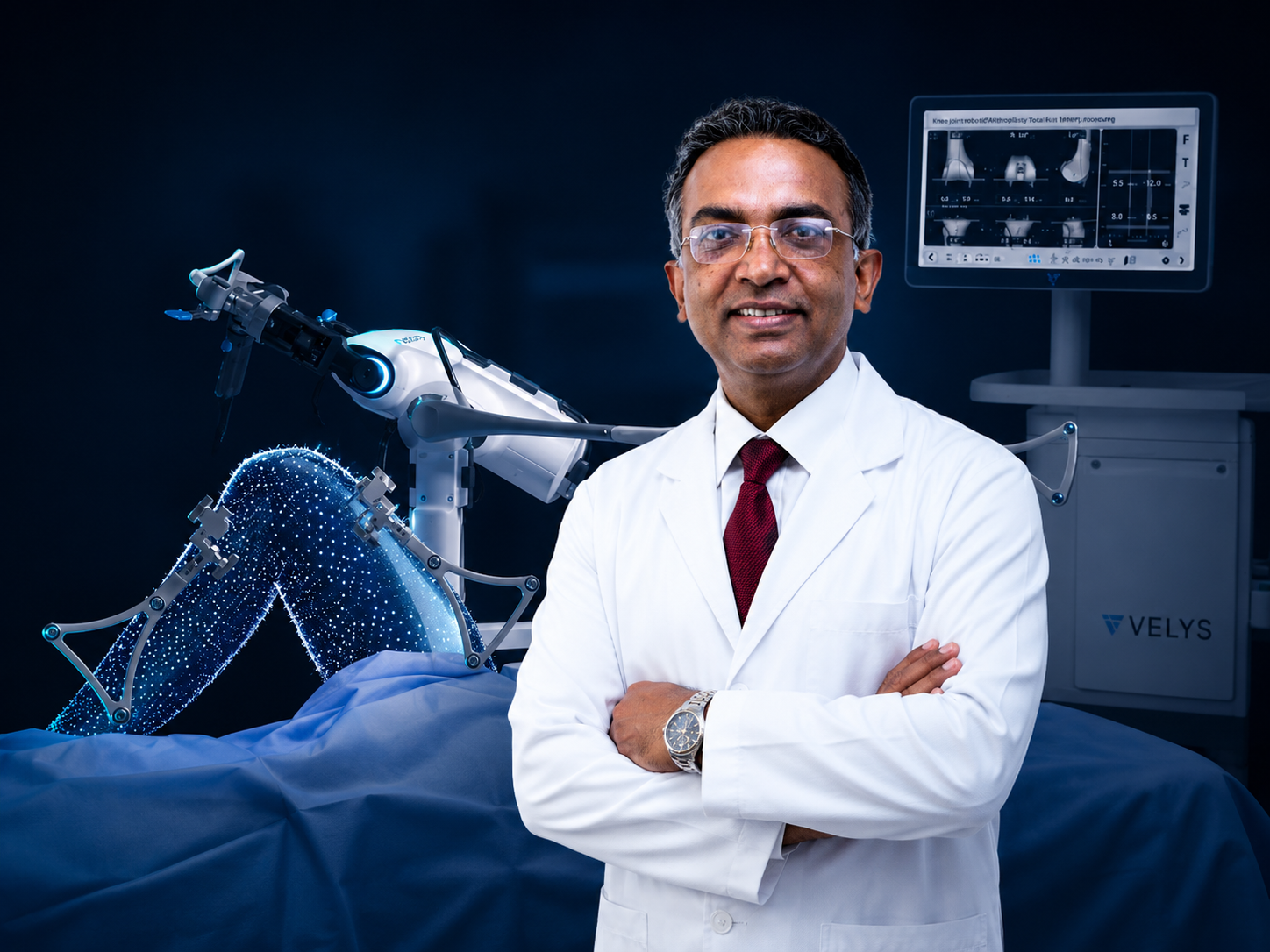
Robotic-assisted total and partial knee replacement uses your own 3D anatomy to plan every cut, every degree of alignment and every ligament balance point — before a single incision is made.
What is robotic knee replacement?
Robotic knee replacement is a computer-assisted surgical technique in which a robotic arm helps the surgeon place the implant with sub-millimetre precision. It does not replace the surgeon — it enhances the surgeon's judgement with real-time 3D data, tactile feedback and safe motion boundaries.
For patients, this means less bone removal, more accurate implant alignment, better preservation of soft tissue, and often a noticeably quicker return to walking, climbing stairs and daily activities.
Dr. Tomar performs both total knee replacement (TKR) and partial (uni-condylar) knee replacement using robotic assistance, matching the procedure to what the patient actually needs — not to what a hospital prefers to promote.
Why robotic
Six advantages patients feel
Robotic navigation aligns implants to your unique anatomy within ±1° accuracy.
Balanced ligaments and preserved motion for a knee that feels more like your own.
Smaller incisions and reduced soft-tissue trauma mean you walk sooner.
Accurate alignment reduces wear — improving 15–20 year implant survival.
A 3D pre-operative plan built from your CT scan, reviewed before surgery.
Real-time verification during surgery reduces variability and revisions.
Your procedure
What to expect, step by step
- Step 1Pre-operative planning
A CT scan of your knee is used to build a personalised 3D plan of your bone anatomy, alignment and ligament tension.
- Step 2Anaesthesia & positioning
Typically spinal or combined anaesthesia. You will be awake but comfortable, with your leg carefully positioned.
- Step 3Robotic-assisted surgery
The robotic arm guides each bone cut precisely to the plan. Dr. Tomar makes every clinical decision in real time.
- Step 4Implant placement & balancing
Trial components verify motion and stability, then the final implant is fixed and the incision closed.
- Step 5Same-day mobilisation
Most patients stand and walk a few steps within 4–6 hours with support and pain well controlled.
- Step 6Structured recovery
Guided physiotherapy, home exercises, remote check-ins and a return to daily life within weeks — not months.
Recovery journey
Your recovery, week by week
Most patients follow a predictable arc after robotic knee replacement. Individual timelines vary, but here's the pattern we plan around.
- 1Day 0Surgery day
Procedure typically takes 60–90 minutes per knee. You'll rest, eat a light meal in the evening, and stand with support within 4–6 hours.
- 2Day 1–2In hospital
Walking with a walker, gentle knee bending exercises, pain controlled with oral medication. Most patients go home in 2–3 days.
- 3Week 1–2Early home recovery
Physiotherapy at home, daily walking, stairs with support. Sutures/clips removed around day 12–14.
- 4Week 3–6Confidence phase
Walking without support, driving resumed (right knee: ~4 weeks), most desk work possible from week 3.
- 5Week 6–12Strength & routine
Full return to daily activities, light gym, cycling, swimming. Knee bending progresses toward 120°+.
- 63–6 monthsBack to your life
Long walks, travel, dancing, low-impact sport. Most patients say the knee 'feels like their own' by 4–6 months.
Clearing the air
Knee replacement myths patients often hear
A lot of what patients hear about joint surgery is outdated. Here's the reality.
Signs your knee needs expert evaluation
Joint pain is common — but some signs mean it's time to stop self-managing and get expert evaluation.
- Pain that wakes you up at night or persists at rest
- Difficulty climbing stairs, standing from a chair or squatting
- Visible bow-leg or knock-knee deformity that has worsened
- Locking, giving way or grinding sensation in the knee
- Reduced walking distance — less than you managed a year ago
- Painkillers, physiotherapy and injections no longer helping
- Swelling that returns whenever you're active
Questions patients ask
Frequently asked questions
Book Appointment
Schedule your consultation
Every joint replacement journey begins with a careful, personalised evaluation. Share your details and our team will get in touch to confirm your appointment.
- Consultation hours
Mon – Sat, 10:00 AM – 6:00 PM
- Tomar Orthopaedics
90, New Rajdhani Enclave, Vikash Marg, Delhi – 110092
Next step
Take the next step towards better joint mobility
Book a consultation, request a callback or reach us on WhatsApp — we'll help you understand your options clearly, before any decisions are made.